

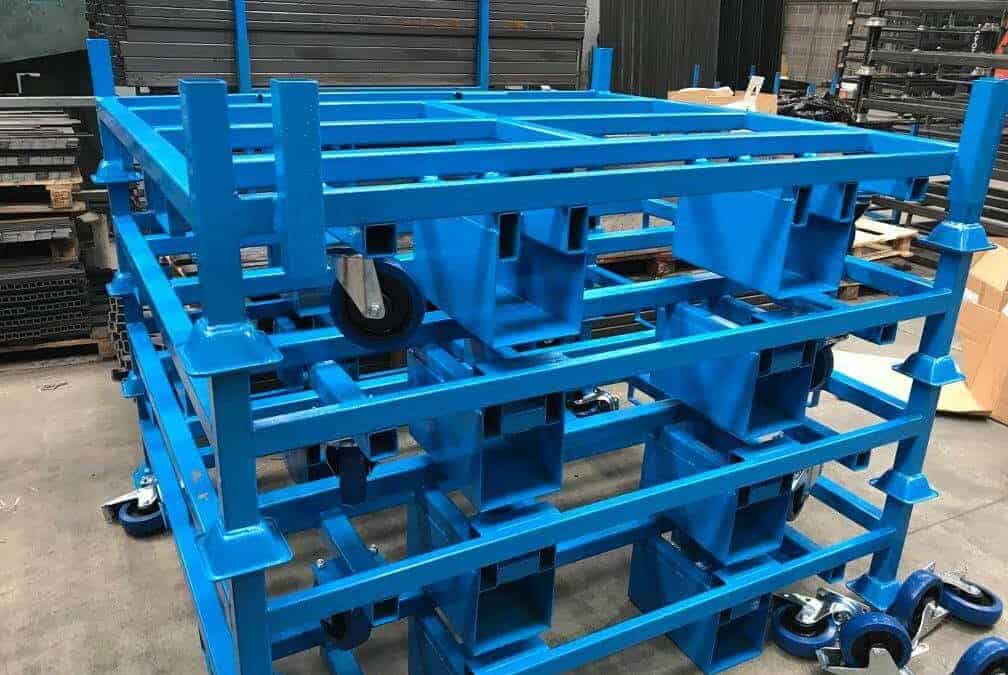
On a construction site, a stillage has to do more than hold stock. It needs to take a full load of scaffold tube or rebar, stack four or five high without twisting, and survive being dragged through mud for a decade. That’s a different spec from a warehouse stillage, and it’s why heavy duty stillages exist in their own category.
Range Storage has manufactured heavy duty stillages for UK construction, scaffolding and civil engineering clients since 1979. We cover what separates a heavy duty stillage from a standard one, the types most commonly seen on UK sites (including scaffold, drop-bottom and rebar formats), the lifting and compliance expectations that apply under LOLER and PUWER, and the spec points that matter most when you’re ordering a batch for a job.
What makes a stillage heavy duty?
Heavy duty isn’t a regulated term, so on paper it means whatever the supplier says it means. In practice, a heavy duty stillage is built around four specifications:
- Steel gauge: usually 3mm to 6mm plate for the base, and 50x50mm or larger square hollow section (SHS) for the frame and corner posts.
- Safe Working Load: typically 1,000kg to 3,000kg UDL, with the higher end reserved for bespoke builds.
- Stack rating: rated to take the combined weight of three to five loaded stillages stacked above without deflection.
- Lifting points: forklift pockets at minimum, with crane-lift lugs on any stillage rated for craning or HIAB handling.
A light warehouse stillage at 500kg SWL will not survive a construction site. It bends under the weight of rebar, the pockets crush under repeated fork entry, and the welds crack at the first awkward crane lift. Spec’ing heavy duty from the start is cheaper than replacing a bent fleet halfway through a two-year project.
Types of heavy duty stillage used on UK construction sites
Most sites end up with a mix of stillage types, matched to the trade and the materials being stored. The common types are below.
Scaffolding stillages
Long, flat-based stillages sized around scaffold tube and fittings, often in 4m and 6m lengths with drop-down or removable side panels. Four-post and six-post variants keep tubes contained during crane lift, and a separate fittings bin usually sits alongside for couplers, clamps and boards. Scaffold-specific stillages are specified by NASC member contractors and are the most common heavy duty format on UK sites.
Post stillages
Used for smaller loads that need stacking: machined components, pre-cut timber, insulation panels, and mid-sized fittings. Demountable posts collapse the stillage to a base plate when empty, cutting return-trip footprint.
Drop-bottom stillages
A stillage with a hinged or fully opening base, designed to release aggregates, hardcore, broken concrete or bulk materials directly into a skip, mixer or chute. Drop-bottom designs replace the need to tip a stillage with a forklift, which removes a common source of site accidents. Range Storage manufactures drop-bottom stillages in several capacities, from small on-site units up to bulk-material capacity.
Rebar stillages
Rebar stillages are usually specified as bespoke builds, typically based on a scaffold stillage frame adapted for length, weight distribution and end-retention of bar bundles.
Mesh stillages and brick cages
Welded mesh stillages in heavy duty gauge are used for bricks, blocks, fence panels and any material that benefits from being visible and ventilated on site. Brick cages and fence panel cages are sector-specific variants, sized to common UK pallet dimensions and rated for stacking in brick merchant yards.
Bulk bag stillages
Open-topped steel frames that hold a one-tonne FIBC (bulk bag) while it’s being filled, moved or emptied. A bulk bag stillage turns the bag into a rigid, forkliftable container, which is how most UK sites handle sand, gravel, aggregates and reclaimed material. See our bulk bag stillage handling article for specification detail.
IBC and gas bottle stillages
Purpose-built frames for IBC totes (bulk liquids, fuels, chemicals) and gas bottle cages for LPG, oxygen and acetylene. Both get specified on civil engineering and construction sites where regulated materials need to be stored, moved and inventoried safely.
Lifting and handling on site
Site stillages see three kinds of handling: forklift, telehandler and crane. Each puts a different stress on the stillage, and a genuine heavy duty spec accounts for all three.
- Forklift pockets: Four-way entry is worth spec’ing where forklifts approach from mixed directions.
- Telehandler access: same pockets, but the stillage needs a flat, reinforced base to handle the weight distribution of a telehandler carriage.
- Crane and HIAB lifting: four certified lifting lugs at the corners, welded into the frame and rated to the SWL. Crane lifts are subject to LOLER and need a documented thorough examination before the first lift.
On tight urban sites where cranes can’t reach, HIAB handling becomes the default. That increases the importance of clean lifting lugs and full chain clearance around the top of the stillage.
UK compliance: LOLER, PUWER and certification
Three pieces of regulation apply to almost every construction-site stillage:
- PUWER 1998 covers work equipment. A stillage is work equipment, and needs to be suitable, maintained and inspected. Anyone bringing stillages onto site is responsible for PUWER compliance in relation to their use.
- LOLER 1998 applies whenever a stillage is lifted with a crane or HIAB. Under LOLER, lifting accessories (slings, shackles, chains) require thorough examination every 6 months. Other lifting equipment requires examination every 12 months, or every 6 months if used to lift people. A stillage designed to be lifted with a load falls within LOLER’s scope and must be thoroughly examined on the appropriate interval, with a valid report of thorough examination available on site.
ISO 9001 and NASC membership (for scaffolding) are the two trust markers most UK principal contractors look for. Our UK stillage safety regulations guide goes deeper on what inspectors want to see.
Specifying heavy duty stillages for a project
For most procurement jobs, the specification conversation covers six things:
- Load type and weight: steel, aggregate, tube, bulk bag, mixed. Heaviest single load determines SWL.
- Stack height needed: the bottom stillage in the stack dictates the minimum gauge.
- Lifting method: forklift only, or crane/HIAB. Crane spec adds certified lifting lugs and LOLER documentation.
- Site environment: galvanised finish for outdoor or coastal sites, powder coated for mixed-use or colour-coded fleets.
- Dimensions: standard UK pallet footprint (1200x1000mm), Euro (1200x800mm), or bespoke.
- RAMS alignment: the stillage spec needs to be compatible with the site’s Risk Assessment and Method Statement for material handling.
Bespoke builds are the norm rather than the exception on large sites. Range Storage’s in-house CAD and fabrication lines produce engineered drawings, Finite Element Analysis on load-critical components, and welded prototypes before a batch goes into production. See our fabrication services for the full scope.
Repair, refurbishment and project lifecycle
Heavy duty stillages get hit. Forks catch them, loads drop in, and by the end of a 12-month project a fleet can be visibly beaten up. The choice is whether to replace them or refurbish them, and on long programmes the cost maths usually favours refurbishment.
A proper refurbishment covers: straightening bent uprights, re-welding cracked joints, replacing damaged mesh panels and stripping and re-finishing the stillage. Range Storage’s repair and maintenance service does this at the Dewsbury plant, on stillages we built and on stillages built by other manufacturers. A 10-year lifecycle with one mid-life refurbishment tends to work out cheaper than two-fleet replacement across the same window.
Specify once, run the project
A heavy duty stillage is a piece of site equipment that earns its place by outlasting the project. Under-spec the gauge, skip the lifting certification or cut the finish and the cost comes back in replacements, failed inspections and delayed lifts. Over-spec is cheaper than under-spec every time on a site budget.
Range Storage manufactures heavy duty stillages in steel, scaffold, drop-bottom, rebar, mesh and bulk-bag formats from our British manufacturing base, all certified, documented and available for bespoke builds. If you’re spec’ing a site fleet, speak to the Range Storage team for a CAD drawing and a quote to your tonnage and dimensions.

Recent Comments