
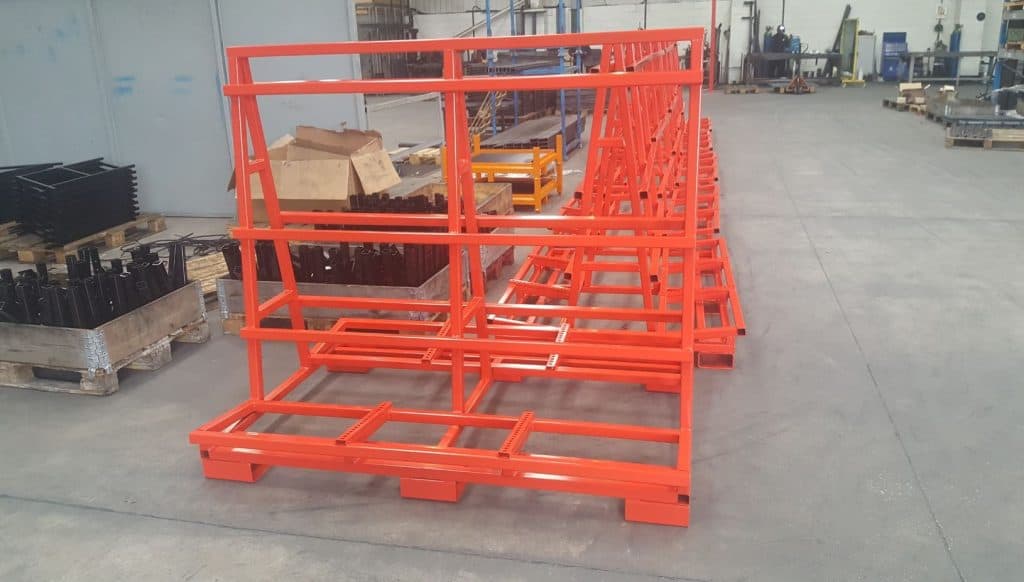
Powder coating and galvanising are the two protective finishes that dominate UK stillage manufacturing, and the choice between them comes down to environment, budget and how hard the stillage is going to be worked. Powder coating is a baked-on polymer finish with good abrasion resistance and any RAL colour you want.
Galvanising is a bonded zinc layer that sacrifices itself to protect the steel underneath, built for outdoor and corrosive environments. Either finish will outlast a cheap imported stillage, but they do different jobs, and getting the choice right matters more than most buyers realise at the quote stage.
Keep reading to learn how each finish actually works, the UK standards that sit behind them, realistic stillage lifespans (not the generic steel-industry numbers), when to specify which, and where a duplex system or a refurbishment earns its place instead.
How powder coating works
Powder coating is a dry finishing process. Powdered polymer (usually polyester, epoxy or an epoxy-polyester hybrid) is electrostatically sprayed onto the steel, then cured in an oven at around 180-200°C. The powder melts, flows and crosslinks into a continuous, hard polymer film. A typical dry film thickness (DFT) on a stillage is 60-100 microns.
Key strengths:
- High abrasion and impact resistance, which matters on a stillage that gets forklifted and stacked daily.
- Any RAL colour, high-gloss or matt, for fleet segregation, hazard zones or brand colours.
- Low VOCs compared to wet paint; generally the more environmentally defensible option.
- Recoat and touch-up are practical when damage is localised.
Key limitations:
- Powder coating is a barrier, not a sacrificial system. Chip through the film to bare steel in a damp environment, and rust will start at the chip and creep under the coating.
- UV exposure causes some powders to chalk or fade over time, particularly in outdoor use.
- Lead time is a factor: in-house powder coating (like ours) is faster than sub-contracting to a third party.
How galvanising works
Hot-dip galvanising (HDG) is a metallurgical bond, not a coating in the polymer sense. The steel is cleaned, pickled, fluxed and then dipped into molten zinc at around 450°C. The zinc reacts with the steel surface to form a series of zinc-iron alloy layers topped with pure zinc.
The real strength of galvanising is sacrificial protection. Zinc is electrochemically more active than iron, so when the coating is scratched to bare steel, the surrounding zinc oxidises instead of the exposed steel. That’s why galvanised stillages survive outdoor and wet environments where a pure polymer coating would corrode at the first chip.
Key strengths:
- Outstanding corrosion performance in outdoor, coastal, wet and chemically aggressive environments.
- Sacrificial protection at damage points.
- Long-established UK standards framework: BS EN ISO 1461 for the coating, BS EN ISO 14713 for design guidance.
- Very low maintenance over its service life.
Key limitations:
- Silver-grey finish only; no colour options without a secondary coating.
- Aesthetic inconsistency from dip to dip (bloom, runs, drainage marks).
- Significantly higher upfront cost than powder coating in most configurations.
- Longer lead time if not done in-house.
Where duplex systems make sense
A duplex system is galvanising followed by powder coating, specified to BS EN 13438. It combines the corrosion performance of zinc with the appearance and abrasion resistance of powder. Sweep-blasting or T-wash of the galvanised surface is required before the powder layer, otherwise adhesion is unreliable.
Duplex makes sense when you need both a long outdoor service life and colour coding or corporate branding: rental fleets, council-owned assets, food-sector stillages in mixed indoor/outdoor zones. It costs more up front than either single finish and delivers a service life that usually exceeds the sum of the two individual lifespans.
Lead time, colour and refurbishment
Most UK stillage orders get delayed at the finishing stage, not the fabrication stage. In-house powder coating keeps stillage production on a single site and cuts typical lead times by one to two weeks versus sub-contracted finishing. Galvanising adds lead time because the stillages have to ship to a galvanising plant, be dipped in batches, and come back for inspection.
On colour: powder coating gives you any RAL shade. We powder coat stillages in food-safe colours for allergen segregation, in Pantone-matched corporate colours for branded rental fleets, and in high-visibility hazard colours for mixed pedestrian/forklift zones. Galvanising gives you one colour: zinc.
Refinishing existing stillages is the third route most buyers overlook. A well-built stillage with a damaged finish often has more life left in it than the coating implies. Our stillage repair and maintenance service covers stripping, re-prep and full recoat at the Dewsbury plant, on stillages we built and on stillages built by other manufacturers. See our maintenance guide for when refinishing makes more sense than replacing.
How to choose
Three questions answer most powder-vs-galvanised decisions:
- Indoor or outdoor? Indoor warehouse: powder coating. Outdoor or mixed: galvanising or duplex.
- Do you need colour? If yes, powder coating (or duplex if you also need outdoor corrosion resistance). If not, galvanising is the low-maintenance default.
- What’s the 10-year plan? A stillage in heavy service for a decade costs less galvanised. A stillage in a clean indoor warehouse costs less powder coated and colour-coded.
For anything borderline or spec-critical, ask the manufacturer to spec the finish against your corrosivity category (BS EN ISO 12944), not against a generic “outdoor-rated” claim.
Spec the finish, not just the stillage
The finish is what determines how long the stillage stays on the floor, and it’s the one specification most buyers defer to the supplier without asking. A stillage is only as good as the coating protecting it, and the coating is only as good as the pre-treatment underneath.
Range Storage manufactures, powder coats and refurbishes steel stillages at our Dewsbury plant, with galvanising available via our partner network and British manufacturing backing every order. If you want the finish matched to your environment, your fleet colour scheme and your corrosivity category, speak to the Range Storage team or see our powder coating service page for the in-house capability.

Recent Comments