

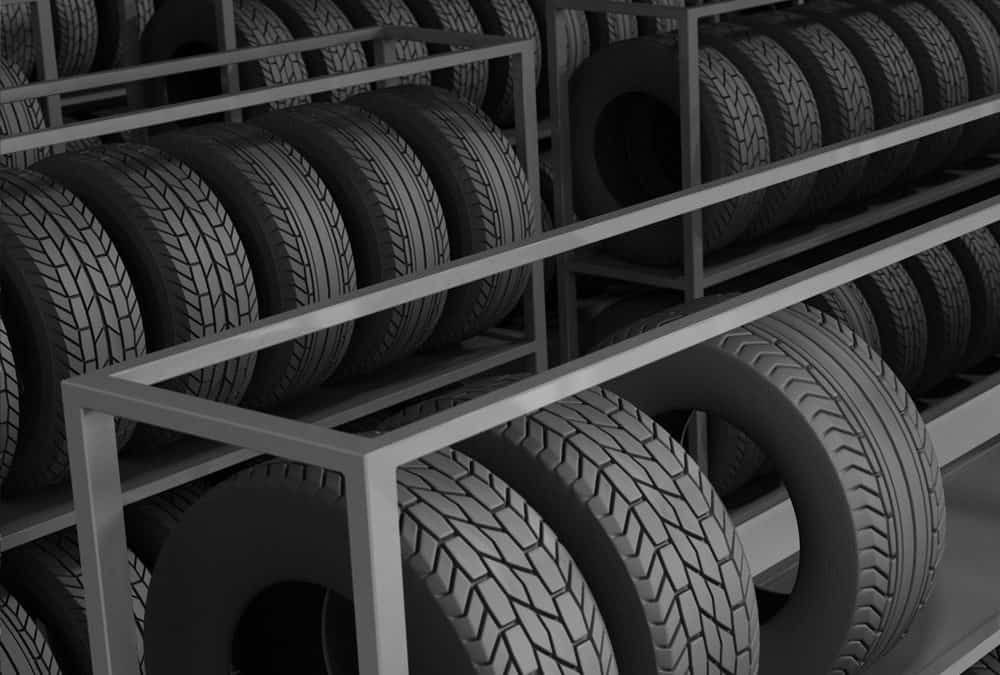
Tyres are more demanding to store than they look. Rubber degrades when it is left in the wrong conditions, a pile of tires is a serious fire load, and a workshop that holds seasonal stock has to keep hundreds of them organised, accessible and off the floor. Get it right and your stock stays saleable and your site stays safe; get it wrong and you are looking at perished rubber, a failed fire risk assessment, or a changeover week spent digging through a heap on the floor. With the winter tyre changeover driving stock levels up, now is the time to get storage in order.
Range Storage has manufactured steel stillages in Britain since 1979 and is one of the UK’s largest makers of tyre stillages. We set out how to store tyres safely in a workshop or warehouse: the conditions rubber needs, the UK rules that apply, whether to store tyres upright or stacked, and the equipment that keeps a growing stock organised and compliant.
Why does safe tyre storage matter?
There are three reasons to take tyre storage seriously, and they stack on top of one another:
- The rubber. Tyres are a chemical compound that degrades with exposure, and the damage is often invisible until a sidewall cracks. Manufacturers warn that tyres left in poor conditions for a month or more can dry out and develop surface cracks that take them out of service.
- Fire. A quantity of tyres represents a significant fire load, burns fiercely once alight, and produces thick, toxic smoke that is hard to control. Any workplace storing tyres needs that risk reflected in its fire risk assessment under the Regulatory Reform (Fire Safety) Order 2005.
- Safety and efficiency. Tyres stored loose in heaps are a manual handling and trip hazard, they are slow to search through, and they make stock rotation almost impossible. Organised storage fixes all three at once.
What are the rules for storing tyres in the UK?
Two sets of rules matter for a workshop or warehouse:
- For the tyres you hold as serviceable stock, the key legal duty is fire safety. The responsible person for the premises must carry out and maintain a fire risk assessment, and given how tyres behave in a fire, that means keeping storage away from ignition sources, maintaining clear access, and following any limits your fire risk assessment or insurer sets on how much is stored and where.
- For scrap and part-worn tyres destined for disposal, the waste rules apply. According to the Environment Agency, storing and treating end-of-life tyres for recovery is covered by a registered T8 exemption up to set limits, commonly 40 tonnes of car tyres or 60 tonnes of truck tyres over any seven-day period, with tyres kept in piles no larger than 10 tonnes separated by fire breaks. Larger operations need a full environmental permit, and waste tyres must be passed to a registered waste carrier for collection. If your site accumulates old tyres, treat that stock as waste and store it accordingly.
What conditions do tyres need to be stored in?
Serviceable tyres keep best in conditions that protect the rubber from the things that age it. Store them in a cool, dry, dark and well-ventilated indoor space, and keep them away from the following:
- Sunlight and UV, which break down the rubber, so keep tyres out of direct sun and away from sunny walls and windows.
- Ozone sources, such as electric motors, generators, battery chargers and welding equipment, which cause sidewall cracking surprisingly quickly. Keep tyre storage well clear of running electrical plant.
- Heat and flames, including hot pipes, heaters and any source of sparks.
- Chemicals, solvents, oils and fuels, which attack the rubber on contact.
Aim for a moderate, stable temperature rather than a hot or freezing corner of the building. Manufacturers such as Michelin suggest a range of roughly minus ten to plus thirty degrees. It also pays to clean tyres and remove any stones or debris from the tread before they go into storage.
Should tyres be stored upright or stacked?
How you orient tyres depends on whether they are mounted on wheels, and getting this wrong deforms the rubber.
Unmounted tyres, with no wheel fitted, should be stored upright and side by side, standing on their tread like books on a shelf. Standing them vertically avoids the distortion that comes from weight bearing down on a stack, and rotating them a little from time to time helps them keep their shape over a long storage period.
Tyres mounted on wheels are handled the other way around. Because the wheel holds the shape, mounted and inflated tyres are best stacked horizontally in modest piles, or hung, rather than stood on the tread. Keeping these two groups separate in your storage layout is the simplest way to make sure each is stored the right way up.
Keeping tyres off the floor: stillages and racking
The practical answer to all of the above is purpose-built storage that lifts tyres off the floor, holds them in the correct orientation and keeps the stock contained and accessible. This is where tyre stillages earn their place. A steel tyre stillage holds tyres securely upright, stacks safely so you use the building’s height rather than its floor, and can be moved by forklift as a single unit, which takes the manual handling out of a changeover.
Three points make the difference when you set up stillage or rack storage:
- Respect stacking limits. Build stable columns within sensible limits rather than towering, unstable heaps. Our guidance on safe stacking heights applies directly to stacked tyre stillages.
- Let air move. Open and mesh designs keep air circulating around the tyres, which suits the cool, ventilated conditions rubber needs.
- Use your vertical space. Where a site runs racking, integrating stillages with pallet racking lets you store far more tyres in the same footprint while keeping fire-break gaps clear.
Because we fabricate in-house, tyre stillages can be sized to your tyre mix and your available space rather than forcing your stock into a standard frame.
How should you manage the seasonal changeover?
Workshops that swap customers’ winter and summer tyres hold a lot of stock for months at a time, and organisation is what keeps that profitable. Label each set clearly with the customer, vehicle and position, so the right tyres come back out quickly. Keep each customer’s set together in one stillage or bay, and work on a first-in, first-out basis for stock tyres so nothing sits long enough to perish. A tidy, well-indexed storage system turns the changeover from a scramble into a quick, safe routine.
Store your tyres safely with Range Storage
Since 1979 we have manufactured more than half a million stillages, pallets and cages for British industry, and we are one of the UK’s largest makers of tyre stillages, every one designed, fabricated and powder coated in our own West Yorkshire factory from UK-sourced steel. Whether you run a single workshop or a national tyre operation, our in-house team can help you specify storage that keeps your tyres safe, compliant and easy to handle.
Call our team on 01274 736363 for expert advice, or contact us for a free, no-obligation quote.

Recent Comments