
It’s simple: warehouse floor space costs money. Every square metre tied up in inefficient storage represents a lost opportunity, whether it’s additional inventory, processing space, or improved workflow. And if you’re facing mounting pressure to store more while working with the same footprint, you may find that single-level storage methods simply don’t cut it anymore.
Stackable stillages are a practical solution that can transform how you use vertical space. By creating stable, multi-level storage systems, these units help you multiply capacity without expanding your building.
Why Does Warehouse Floor Space Present Such a Challenge?
Floor-level storage consumes space faster than most operations expect. When goods sit on standard pallets or in non-stackable containers, you’re limited to single-layer layouts that spread out across the warehouse and leave valuable vertical space untouched.
The result is predictable: you pay for cubic metres but use only a thin slice of that volume. Wide aisles between low-level storage rows take up even more room without increasing capacity. Before long, the warehouse feels full, and you’re weighing costly options like building extensions or renting off-site storage.
There’s also a hidden cost. As stock spreads across larger floor areas, manual handling increases. Staff walk further, forklift operators travel longer routes, and simple tasks take more time than they should. Over a full shift, these inefficiencies multiply – driving up labour costs and slowing the entire operation.
What Makes Stackable Stillages Different from Traditional Storage?
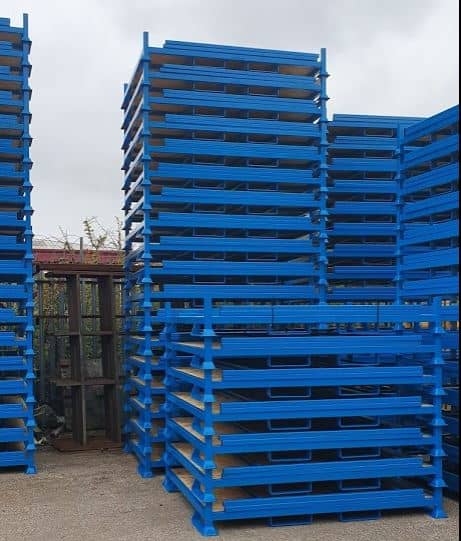
Stackable stillages are purpose-built steel cage units. They have heavy-duty steel frames with integrated stacking corners or feet that lock together when stacked. This way, these steel stillages can form stable towers that reach several units in height, depending on load weight.
The steel mesh or sheet metal construction provides visibility and ventilation while protecting contents from damage. Integrated fork pockets allow forklift access from any side, making loading and unloading straightforward even when units are stacked.
How Do Stackable Stillages Transform Vertical Space into Usable Storage?
The math is certainly compelling: a stillage that stacks four units high can quadruple storage capacity within the same floor footprint. You gain all that extra space without expensive racking systems or structural changes to your building.
Space Efficiency Gains
Stacking vertically reduces the floor area needed for the same storage volume. What once took 100 m² might now occupy just 25 m². That freed-up space can be used for processing areas, extra stock, or easier access routes.
Operational Improvements
Forklift operators can retrieve multiple stacked units from a single location, cutting travel time and fuel costs. Uniform stillage dimensions create organised storage zones, making inventory management and stock location quicker and simpler.
Cost Savings
By avoiding warehouse expansion or off-site storage, you save money immediately. The investment in stackable stillages usually pays back quickly through space efficiency and operational improvements.
Which Stillage Configurations Work Best for Different Warehouse Applications?
Choosing the right stillage depends on what you store and how you need to access it. Different designs suit different needs.
Mesh-Sided Stillages
Mesh-sided stillages offer visibility and airflow, making them ideal for parts, components, or items that need ventilation. The mesh lets you check inventory at a glance, without opening the units. Steel sheet-sided versions provide weather protection and security for sensitive items or outdoor storage.
Drop-Side Stillages
Drop-side stillages feature hinged gates for easy access to contents at any stack level. They’re perfect when you need to pick individual items without unstacking the entire tower. Collapsible versions fold flat when empty, saving space and reducing transport costs on return trips.
What Loading Capacities Should Guide Your Stillage Selection?
Weight capacity determines safe stacking heights and operational efficiency. Heavy-duty stillages designed for 1000 kg loads require different engineering than lighter units. Knowing your typical load weights helps you choose the right specifications.
Stacking limits depend on the base unit and overall construction strength. A 1000 kg stillage might safely stack three high with full loads, while lighter 500 kg units could stack four or five, depending on the contents. Fork pocket design also affects handling safety – wide, reinforced pockets provide stable forklift engagement, especially when lifting upper units. Finishes like powder coating or galvanising improve durability but don’t change structural capacity.
How to Successfully Implement Stackable Stillages
Implementing stackable stillages requires careful planning and operator training. Follow these steps to get the most from your vertical storage:
- Assess ceiling height and forklift clearance. Make sure there’s enough room for safe stacking and equipment operation.
- Determine safe stacking limits. Consider stillage load ratings and floor load capacity when planning stack heights.
- Plan storage zones. Organise stacks around weight distribution and workflow to maximise efficiency.
- Train operators. Ensure forklift drivers know proper stacking and unstacking procedures.
- Establish inspection protocols. Check stillage condition regularly and maintain stable stack alignment.
- Integrate with existing storage methods. Combine stillages for bulk items with bins for small parts or trolleys for mobile applications to optimise space without replacing your entire system.
Get Space-Saving Stillage Solutions with Range Storage
At Range Storage, we’ve been designing and manufacturing British-made steel stillages for UK warehouses since 1979. As a second-generation, family-owned business, we combine 40+ years of experience with ISO 9001-accredited quality. We use UK-sourced steel, skilled welders, and complete in-house control from design to delivery. This ensures every stillage is built to last and tailored to your needs.
Our team helps businesses maximise floor and vertical space with practical, bespoke solutions that fit your workflow, protect your investment, and improve efficiency. With more than 500,000 stillages manufactured, we understand how to solve complex storage challenges while keeping operations going.
Get in Touch with Our Team
Contact us to discuss your warehouse space requirements. We’ll help you identify stillage configurations that deliver lasting value and fit into your operation.

Recent Comments