
The containers used to move and store goods are important operational assets that can impact safety in the workplace, efficiency, and ultimately, a business’s bottom line. Steel stillages and plastic pallet boxes each offer distinct advantages, but understanding their performance differences can help businesses save money on replacement costs and operational downtime.
In this article, we cover the key differences between steel stillages and plastic pallets and explain why durability matters more than initial cost when choosing industrial storage solutions.
Why Does Material Choice Matter for Industrial Storage?
Material selection affects different aspects of a business’s storage operations. A busy warehouse or factory floor is an environment with risk of impacts from forklifts, heavy loads, and temperature extremes. Storage containers must withstand these conditions day after day, year after year.
The wrong material choice can lead to frequent replacements, safety risks from structural failures, and operational disruptions when containers break unexpectedly. Steel stillages vs plastic pallets have fundamentally different approaches to these challenges, with steel offering resilience where plastic shows vulnerability.
Cost calculations that only consider purchase price can miss the bigger picture. Total cost of ownership can also include factors such as replacement frequency, likelihood of repairs, safety incidents, and operational efficiency throughout the container’s service life.
What Are the Key Differences Between Steel and Plastic Containers?
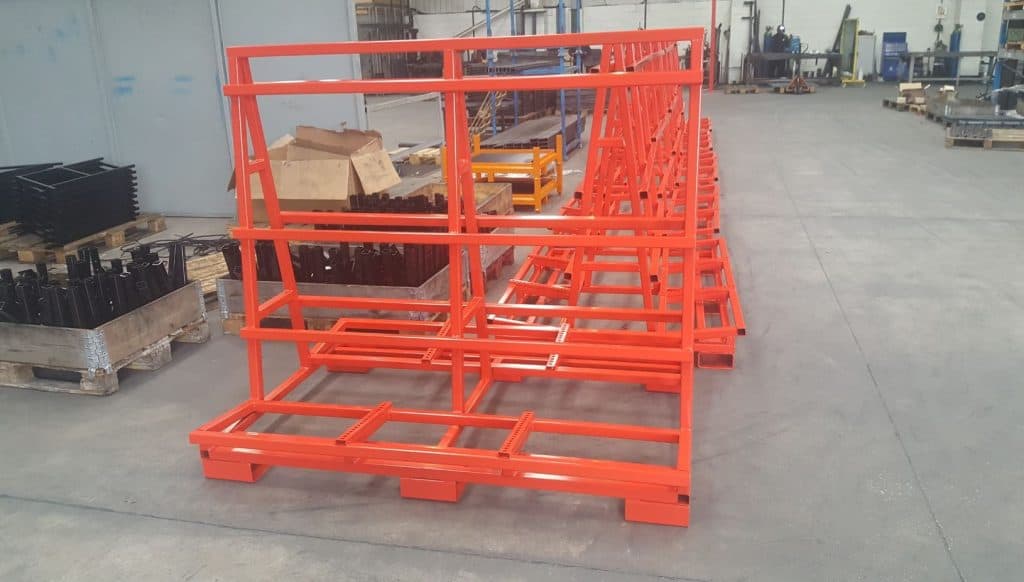
Steel stillages are engineered pieces of industrial equipment, constructed from heavy-duty mild steel and fully welded for maximum strength and rigidity. They can be designed in various configurations, including solid-sided boxes, mesh cages, or post pallets, to suit specific industrial tasks.
Plastic pallet boxes, also known as bulk boxes or dolavs, are often single-piece, injection-moulded containers made from HDPE (High-Density Polyethene). They are lightweight and commonly used in food processing and agriculture for their hygienic properties.
We manufacture steel stillages that are engineered for demanding industrial environments. Our fabricated stillages offer customisation options that plastic doesn’t always provide, allowing containers to fit your process requirements instead of forcing you to adapt your operations to standard sizes.
How Do Steel Stillages vs Plastic Pallets Perform in Industrial Operations?
An important consideration is how steel and plastic perform in day-to-day industrial applications.
Durability and Impact Resistance
Steel stillages can withstand a variety of impacts. A forklift collision might cause a dent, but the stillage will stay structurally sound and serviceable. The fully welded construction helps the container maintain its integrity even after years of hard use.
Plastic boxes become brittle, especially in cold environments like refrigerated warehouses. A direct impact from a forklift tine can crack or shatter a plastic box, rendering it unusable and unsafe. Once damaged, plastic containers cannot be effectively repaired and must be replaced at full cost.
Load Capacity and Stacking Performance
- Steel stillages are engineered for high-load applications, featuring rigid, welded structures that resist deformation under weight.
- Plastic boxes have limited static and dynamic load capacities with walls that can bulge or deform under heavy loads.
- Steel allows safe stacking to greater heights, maximising vertical storage space.
- Plastic deformation that occurs when stacked creates unstable stacks, posing safety risks.
- Steel stillages maintain their shape consistently, providing stable stacking even at maximum capacity.
What are Some Industries that Benefit From Steel Stillages Over Plastic?
Different sectors face challenges where the durability of steel stillages vs plastic pallets becomes especially important for operational success.
Manufacturing and Heavy Industry
Manufacturing facilities handling heavy components, metal parts, and industrial materials rely on steel stillages for their superior load-bearing capacity. The ability to withstand impacts from heavy machinery and resist damage from sharp or abrasive materials makes steel a vital material in these environments.
Automotive and Engineering
Automotive plants require containers that can handle the weight of engine components, gearboxes, and metal assemblies without deforming. Steel stillages provide the structural integrity needed for these demanding applications and offer customisation for specific part configurations.
Construction and Infrastructure
Construction sites require containers that can withstand outdoor conditions, rough handling, and heavy loads. Steel stillages resist weather damage and retain their strength through temperature extremes that would compromise plastic containers.
Warehousing and Logistics
Distribution centres maximising storage density can benefit from steel’s superior stacking capability. The consistent dimensions and structural stability of metal pallets enable efficient use of vertical space without compromising safety.
What Long-Term Cost Advantages Do Steel Stillages Provide?
The true value of steel pallets versus plastic pallets becomes apparent when calculating total ownership costs over time, rather than comparing initial purchase prices.
Lifespan and Repairability Benefits
- Steel stillages can last decades with proper maintenance
- Damaged steel can be repaired through welding and straightening
- Plastic containers must be scrapped when cracked or broken
- One steel stillage can outlast multiple plastic replacements
- Professional repair and maintenance services help restore steel stillages to safe service for a fraction of replacement cost
Customisation Benefits
Steel fabrication enables the design of containers tailored to your processes, reducing inefficiencies associated with using standard-sized plastic boxes. Custom features, such as drop-fronts for ergonomic access, internal dividers for part protection, or specific dimensions to utilise transport space, deliver ongoing operational savings.
As British manufacturers, we can fabricate steel stillages to any size, shape, or configuration your operation requires. This flexibility means your containers fit your process, instead of forcing process changes to accommodate standard container limitations.
How Do You Calculate the Real Cost of Steel Stillages vs Plastic Pallets?
Making an informed decision requires looking beyond quoted prices to understand total lifecycle costs.
Initial Investment Considerations
- Steel stillages are understood to have higher upfront costs than plastic alternatives.
- Plastic boxes offer lower entry prices but hide long-term expenses.
- Budget planning should account for replacement cycles over 5-10 years.
- Steel’s repairability creates residual value that plastic may not offer.
- Custom steel solutions may eliminate the need for multiple container types.
Operational Cost Factors
- Calculate downtime costs when containers fail unexpectedly
- Consider safety incident risks from structural failures
- Factor in labour costs for more frequent replacements
- Account for storage efficiency gains from superior stacking
- Include transportation savings from optimised container dimensions
UK Made Steel Stillage Solutions From Range Storage
Choosing the right storage solution can have a significant impact on your business operations. At Range Storage, we help businesses make informed decisions, focusing on durability, efficiency, and long-term value, rather than just initial cost.
We work closely with clients across our UK locations to understand handling challenges and design steel stillages and workplace equipment that deliver lasting performance. All our products are designed and manufactured in-house at our West Yorkshire factory, using UK-sourced steel and crafted by our highly skilled welders. With ISO 9001 accreditation, state-of-the-art machinery, and a new powder coating spray booth, we maintain full control over quality, finish, and lead times.
Our expertise allows us to create custom steel stillages that outperform plastic alternatives. Unlike plastic pallets, our steel solutions withstand heavy use, extreme conditions, and repeated handling — helping reduce downtime, improve workplace safety, and lower long-term storage costs.
With full in-house CAD design, fabrication, painting, and delivery, we ensure each stillage meets your exact operational needs. Our 25,000 sqft facility and experienced team allow us to deliver solutions that are built to last, with the quality and performance our clients have relied on since 1979.
To find out how our steel stillages can improve efficiency, safety, and long-term value, contact us today.

Recent Comments