

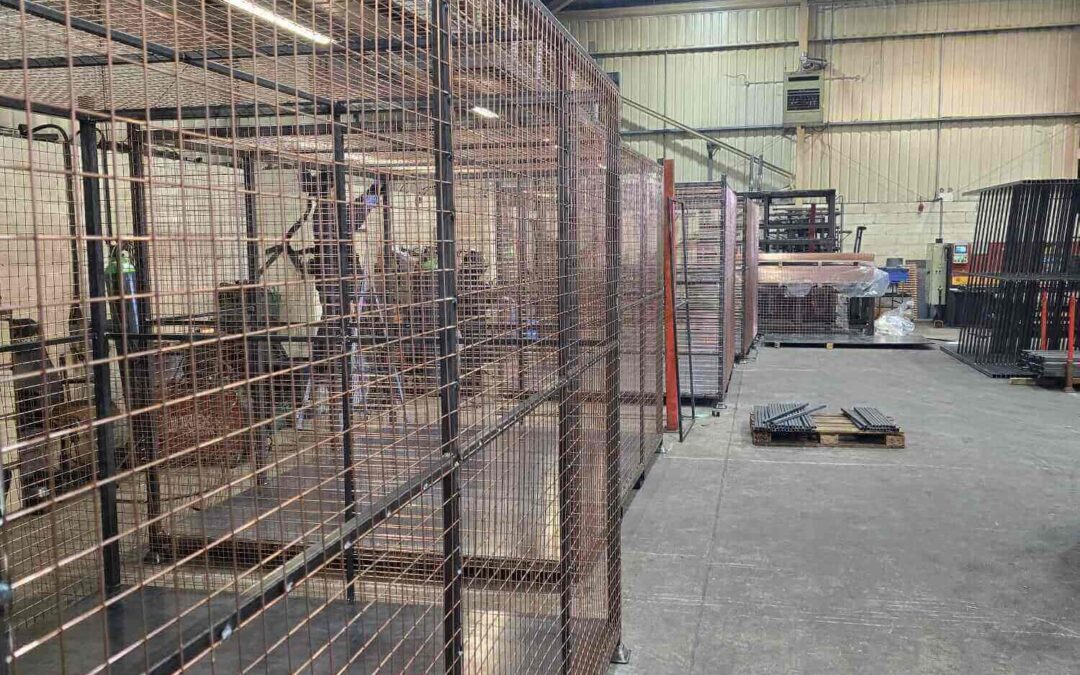
A stillage cage is a steel framework with mesh or sheeted sides, built to hold loose or high-value stock in a warehouse and still be lifted, stacked and locked away. It sits somewhere between a pallet and a full storage unit, giving you the containment of a cage with the handling footprint of a pallet. When a warehouse manager talks about secure stillage cages, this is usually what they mean.
Range Storage has been making stillage cages for UK warehouses since 1979. Everything that leaves the factory is built to order on our in-house CAD and welding lines, finished in our own powder coating facility and backed by ISO 9001 quality management. We explain the types you’ll see on a warehouse floor, how they keep stock secure, the spec points worth insisting on and the UK compliance picture you should be asking about.
What is a stillage cage?
A stillage cage is a stackable, steel-framed pallet with fixed or removable mesh sides, often with a drop-down gate, a lid or a lockable door. The base is usually a full steel deck with forklift pockets underneath. Sides can be welded wire mesh, sheeted steel or a mix of both. Some designs collapse flat when empty to save space; others sit on castors for wheeled handling.
The format gets called a few different things depending on who you’re speaking to: stillage cage, pallet cage, storage cage, metal storage bin or simply “cage pallet”. In practice, they all describe the same piece of kit: a secure, stackable container that can live on a forklift, inside racking or out in a yard.
Types of stillage cage used in warehouse storage
Warehouses rarely use one format across the board. A mix of types tends to work best, matched to what’s being stored and how often it’s picked.
Mesh stillage cages
Welded wire mesh sides,with a reinforced steel frame and base. Mesh gives you visibility, ventilation and a clear view of the SKU without opening the cage. Common across distribution, e-commerce fulfillment and general manufacturing. Mesh cages are the default starting point for most warehouse applications where full concealment isn’t needed.
Lockable stillage cages
A mesh or sheeted cage with a hinged door, padlock hasp and sometimes a steel lid. This is the format specified when the contents are worth stealing: tools, electronics, branded components, catering equipment, spare parts. Lockable stillage cages give you a controlled-access unit inside the warehouse without committing to a full secure room.
Stackable stillage cages
Most steel stillage cages are designed to stack. Corner posts and stacking lugs let you build vertical columns, often four or five high when empty and three or four high when loaded. Stackable cages free up floor space and make seasonal storage viable without new racking. See how stackable stillages help maximise warehouse space for how far this can be pushed.
Collapsible stillage cages
Foldable or demountable cages drop to around a quarter of their assembled height when empty. Useful if stock turns over seasonally or cages come back empty from a delivery. Collapsible designs cut return-freight costs and free up dock space during quiet periods.
Sheeted and solid stillage cages
Sheeted or solid-sided cages have steel panels in place of mesh. They hide the load, keep dust and debris off contents and give better protection to painted or delicate finishes. Common in automotive, aerospace and pharmaceuticals where cleanliness or IP concerns rule out open mesh.
Bespoke stillage cages
Most real warehouse jobs end in a bespoke spec: custom internal dimensions, reinforced bases for heavy castings, divider shelves, specific mesh gauges, integrated stencil plates for SKU IDs. In-house CAD and fabrication is what makes this possible without long lead times.
How lockable stillage cages keep warehouse stock secure
Secure means more than a padlock. A well-built lockable stillage cage combines four things:
- Physical construction. Welded box-section or angle-steel frame, 50x50mm welded mesh (or solid sheet), reinforced corners and a hinged door with a concealed-hinge design. Weld quality matters here, since cheap imports often fail first at the hinge and hasp welds.
- Controlled access. A single padlocked door, serialised padlock numbers and a logbook. Once a cage is sealed, only named people can open it. That gives you a clean audit trail if stock goes missing.
- Visibility without access. Mesh sides let you confirm contents from outside the cage, so stock can be counted, audited and checked without breaking the seal. Sheeted sides hide stock entirely, which is better for theft deterrence but requires different audit procedures.
- Stacking and mobility. Forklift pockets on all four sides, optional castor wheels, and corner posts rated to take the weight of loaded cages above. A stillage cage that can’t be moved or stacked ends up parked in the wrong place.
Lockable cages work best when they’re part of a wider procedure: labelled by stock line, locked at the end of each shift, inspected at set intervals. The cage does the work of the door. The process does the work of the audit.
Load capacity, stacking and construction
Published load ratings across the UK market generally fall between 500kg and 1,500kg UDL (Uniform Distributed Load) per cage, with heavier specifications up to 2 tonnes for bespoke builds. Stack heights run from three to five high, with the bottom cage carrying the combined weight of everything above. Always spec to the loaded stack, not the individual cage.
Key construction points worth checking before you buy:
- Frame section: box section or hollow section steel is stiffer and stacks straighter than angle iron over time.
- Mesh gauge: 50x50mm welded mesh in 4mm or 5mm wire is the common warehouse standard. Thinner wire bends under impact.
- Base type: full steel deck for small items, mesh base for ventilated stock, timber-lined base for painted or polished parts.
- Finish: galvanised for outdoor storage, powder-coated for warehouse use (colour-coding by department is a simple but effective control).
- Forklift entry: 100mm minimum pocket depth, preferably four-way entry.
Our stillage weight capacity and load limits guide walks through the load calculation in more detail.
Where stillage cages fit in UK warehousing
Stillage cages aren’t the right answer for every SKU, but they’re hard to beat for specific applications:
- Manufacturing and engineering: finished components, sub-assemblies, heavy castings and batch-produced parts.
- Automotive and aerospace: lockable cages for branded or IP-sensitive components.
- Distribution and e-commerce fulfilment: returns consolidation, seasonal overflow, high-shrinkage SKUs.
- Construction supply: tools, fixings, small plant and high-value consumables on multi-site jobs.
- Food, chemical and pharmaceutical storage: sheeted or mesh cages with specific finishes for hygiene-zone use.
- Retail back-of-house: loose stock consolidation, cage-to-cage picking, returns handling.
Across all of these, the trade-off is the same. A stillage cage is a container you can lift, stack, lock and move. When that’s what the operation needs, racking and open pallets often aren’t enough on their own.
UK compliance and safety expectations
Most UK businesses buying stillage cages run into three pieces of regulation at some point.
PUWER 1998 covers all work equipment, including stillage cages. It requires you to keep it safe, inspected and suitable for its purpose. Bent frames, failed welds and missing SWL plates are PUWER issues.
LOLER 1998 applies when a cage is part of a lifting operation, for example when it’s craned onto a lorry bed. Stillage cages used this way need periodic thorough examination by a competent person.
Manufacturer standards. ISO 9001 and UKCA marking accreditation all speak to how a cage is designed, welded and tested. Ask for certification and weld records if they matter to your audit trail.
Our overview of UK stillage safety regulations and compliance requirements covers the details.
Specifying stillage cages that last
Imported cages are usually cheaper and sometimes fine for light duty. They most commonly fail at weld joints, hinges and corner posts under warehouse use. A stillage cage bought for a 10-year life should be checked on four fronts: steel grade, weld quality, finish, and the availability of repair after damage. If the supplier can’t repair what they’ve sold, the cage is effectively single-use once it’s knocked out of spec.
Range Storage’s stillages are built on steel, powder-coated on site and backed by a full stillage repair and refurbishment service for minor damage and long-term refinishing. That combination keeps the asset on the floor longer than a replace-only model.
Talk to the manufacturer, not the middleman
A stillage cage is a long-term piece of kit: spec it once, buy it once and it should outlast several sets of racking. The detail work matters more than the headline price: mesh gauge, weld class, finish, locking and load rating all shape what you’re actually getting for the quote.
If you want to talk through a specification, get a CAD drawing of a bespoke stillage cage or cost a batch for a new warehouse fit-out, speak to the Range Storage team today. We’ll quote British-made, ISO 9001 stillage cages built to the exact spec your warehouse needs.

Recent Comments